Need
Help learners bridge the gap between abstract IPA symbols, the sounds they represent, and the physical qualities used to produce them.
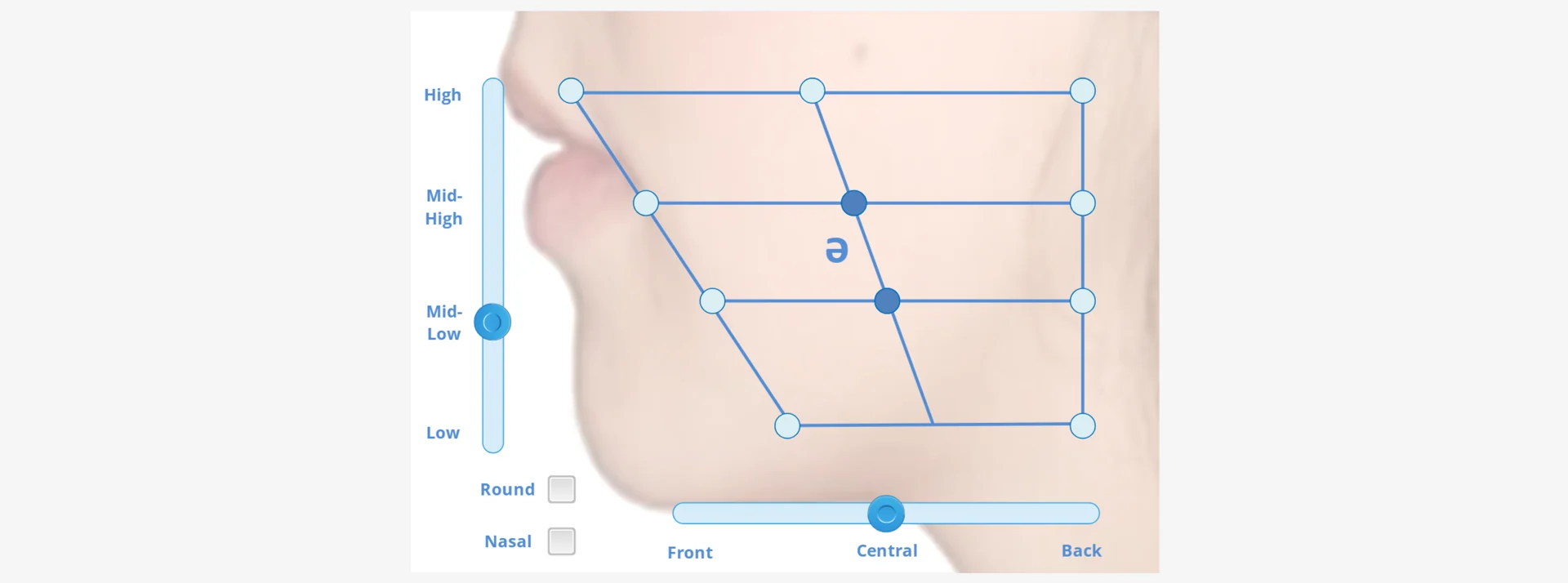
How can learners connect an unfamiliar symbol, a difficult sound, and the physical movement required to produce it?
French pronunciation resources often pair an IPA symbol with a recording, but leave learners to connect those representations to the movement of their own mouths. This simulation maps the French vowel quadrilateral onto a human profile and gives learners direct control over height, frontness, roundedness, and nasality. Each valid combination immediately displays its IPA symbol and plays the corresponding vowel, turning a static chart into an explorable sound-production model.
 Graduate StudentNew York University2017EDCT-GE 2505: Designing Simulations/Games for Learning
Help learners bridge the gap between abstract IPA symbols, the sounds they represent, and the physical qualities used to produce them.
A manipulable mouth model in which sliders and checkboxes control vowel height, frontness, roundedness, and nasality while triggering immediate visual and audio feedback.
A functioning Storyline prototype that transformed the sixteen-vowel French system from a reference chart into an interactive cause-and-effect model.
The prototype demonstrates a viable model for connecting sound, symbol, and articulation through self-paced exploration; learner impact was not formally measured.
This project taught me that even a technically simple prototype can expose a useful mental model when every representation is aligned. The strongest design decision was not adding more explanation; it was placing the sound, IPA symbol, control, and location close enough in space and time for learners to connect them. Building 192 triggers also clarified the limits of authoring-tool logic and helped me distinguish a successful proof of concept from the more dynamic simulation I would ultimately want to build.
Methods & Tools: Articulate Storyline · Interaction design · Discovery learning · Multimedia learning · Dual coding · French IPA · Audio editing